
Case study / 01

Chambers Colombo

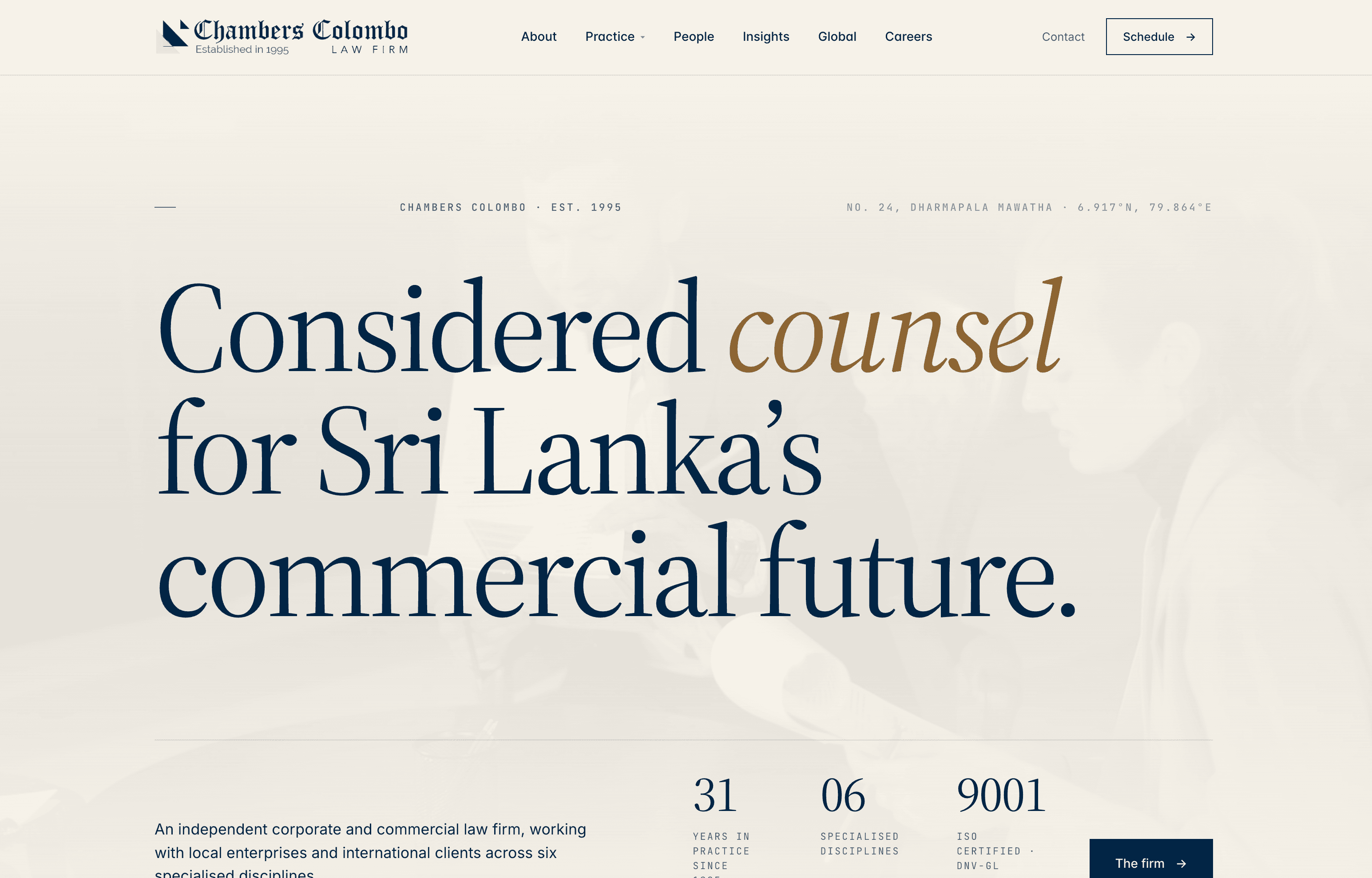
A commercial law practice whose reputation travelled entirely by referral, with a website that gave a prospective client no reason to believe any of it.

Client
Chambers Colombo
Year
In build
Role
UX consultation, design, development
Stack
Next.js, headless CMS, Vercel
Status
Launching soon
Chambers Colombo homepage

01

The problem

Legal buyers do not shop, they shortlist. By the time someone lands on a chambers site they have already been given the name — what they are doing is checking whether the practice looks like it handles work of their size. The old site could not answer that.

Practice areas were a flat list of nouns, the people page was a grid of headshots with no seniority or specialism attached, and there was no way to see a matter the firm had actually run. Every enquiry arrived as a bare email with no context.

02

The approach

We rebuilt the structure around the two questions a shortlisting client actually asks: do you do this kind of work, and who would be doing it. Practice areas became real pages with scope, typical matters and the partners attached to them.

The enquiry path was rewritten to qualify. Rather than a generic contact form, each practice area routes to a short form that captures matter type and urgency, so the first reply can already be useful.

03

The build

Next.js with a content model built around practice areas and people as first-class documents, so a new partner or a new specialism is a form rather than a developer ticket. Statically generated, revalidated on publish.

Restraint was the design brief. A narrow type scale, a lot of white space, and no motion that draws attention to itself — the site has to read as considered, not clever.

▪ Outcome
Practice areas with their own qualified entry point
4
Replaces the generic enquiry inbox
1 form
Developer tickets to publish a new matter
0
Launch scheduled with the client
Soon

Indicative figures — replaced with the client’s own analytics once supplied.